
A Framework for Labelling and Identifying News Sources
Charting a Path Towards News Integrity


In an era dominated by polarising algorithms, generative AI, and pervasive information chaos, ambiguity threatens the very fabric of democratic debate. A multi-layered approach that combines unambiguous technical identification with voluntary, process-based certification offers a sophisticated and pragmatic pathway to reinforcing public trust.
On 25 November, the French media group EBRA organised a debate in which a panel of readers discussed disinformation, foreign interference, social media and media literacy. During the discussion, French President Emmanuel Macron spoke of an “information war” and the need to better equip the public.
When asked about the fight against fake websites and the reliability of sources, he said he was in favour of professional “labelling” to distinguish news media from platforms, echoing the work carried out since the États généraux de l’information (Information Forum), a public consultation whose findings were published in September 2024, and standards such as the Journalism Trust Initiative (JTI), which EBRA holds. The suggestion provoked backlash denouncing the accreditation system as an “authoritarian drift” or a potential “Ministry of Truth.”
In response, the Élysée Palace and government officials clarified that Macron was strictly advocating for a self-regulatory mechanism led by industry professionals, not a state-mandated label. As a successful model for this transparency and ethical evaluation, the President referenced the existing Journalism Trust Initiative (JTI), developed by Reporters Without Borders (RSF).
The JTI’s self-regulatory model contrasts with state-led approaches, recently outrageously illustrated by the White House “Hall of Shame” website, where the US administration singled out three media outlets as being “misleading” and “biased”. It’s precisely the type of state intervention the JTI is designed to avoid.
Some independent critics remain unconvinced, arguing that a top-down labelling approach fails to address the deeper systemic issue of widespread public distrust in traditional information sources. Media literacy is undoubtedly the most sustainable way to address a challenge of this magnitude.
However, if we stick to essential “technical” solutions and professional best practices, a framework providing the infrastructural integrity needed to empower all actors in the ecosystem, from the individual citizen to the global technology platform, with the tools to distinguish authenticity and reward professionalism is a path worth exploring. By architecting a clear separation between identity and quality, it fosters a healthier, more resilient global information ecosystem for the challenges ahead.
The Crisis of Trust and the Quest for Clarity
The weaponisation of digital networks and the marginalisation of professionally reported narratives demand a new architecture for trust, one that enhances the legibility of the information supply chain without resorting to censorship or a state-controlled “Ministry of Truth.”
The central dilemma is how to architect this clarity. The solution lies not in top-down judgment, but in empowering citizens, platforms, and business stakeholders, such as advertisers, to make informed choices through systems rooted in transparency, professional accountability, and robust technical infrastructure. This requires a deliberate bifurcation of two fundamental questions: “Who is this source?” and “Does this source adhere to professional standards?”
In response, several distinct yet related initiatives have emerged as foundational components of this new architecture, moving from reactive content moderation to proactive source verification.
The French États généraux de l’information’s Call to Action
The États généraux de l’information (EGI), launched in France in October 2023, represents a comprehensive, nine-month national consultation involving citizens, journalists, researchers, and public officials. Its strategic purpose was to diagnose the systemic threats facing the public’s right to information and to formulate a framework for safeguarding the civic space in the digital age.
The core findings of the consultation paint a picture of a system under duress. The EGI report identifies several critical threats: the marginalisation of independent, verified narratives; the polarising amplification effects of algorithms; the “weaponisation” of networks in disinformation campaigns; and the disruptive potential of generative AI. In response, the report’s authors conclude that information is not a mere commodity but a “public good” and a “common good” foundational to a functioning democracy.
From this analysis, one of the Steering Committee’s recommendations is a direct call to action for news publishers to undertake a “proactive and wide-ranging labelling process.” The stated goals are threefold: to serve as a “mark of distinction for citizens,” to reinforce public trust, and to rebalance the relationship with digital platforms. Strategically, this recommendation shifts the onus of verification from overburdened consumers and opaque platforms to the content producers themselves, framing transparency as a competitive differentiator.
Crucially, the committee was careful to define the limits of this vision, seeking to empower the industry rather than the state. The report explicitly states its aim is: “…not to advocate for compulsory labelling or impose a single label, but rather to take into account existing categories and labels (such as the general and political information category, the Journalism Trust Initiative and French ARCOM licenses).”
This high-level recommendation for a voluntary, industry-led labelling framework sets the stage for examining the specific, operational solutions that are already putting this principle into practice.
Two Pillars of a Solution: Certification vs. Identification
While the overarching goal is to enhance the legibility of the information ecosystem, the strategic approaches to achieving it can be divided into two distinct but complementary categories. The first is qualitative certification, which assesses and validates a news source’s adherence to professional standards. The second is neutral technical identification, which provides a universal, unambiguous answer to the question of source identity without making any judgment about its quality. Two models, the Journalism Trust Initiative and the Global Media Identifier, exemplify this necessary bifurcation of identity and quality.
The Journalism Trust Initiative (JTI) – A process-based standard for quality
The Journalism Trust Initiative (JTI)*, led by Reporters Without Borders (RSF), is a primary example of a qualitative, process-based labelling system. It serves as a self-regulatory mechanism designed to reward media outlets that adhere to professional journalistic standards. Its credibility is anchored in its status as an ISO standard, developed by a committee of 130 experts, including journalists and technology stakeholders.
The JTI structures its process in three distinct stages designed to ensure rigour and transparency:
Self-Assessment: A media outlet completes a comprehensive online form with 130 questions, which results in a detailed transparency report.
Certification: An external, independent body validates the transparency report, confirming the outlet’s claims.
Benefits: The mechanism is designed to provide concrete rewards, such as enhanced visibility on platforms or better terms with advertisers, for news content respecting professional editorial processes.
The initiative has seen significant global uptake. According to Le Monde, 2,430 media outlets across 127 countries had begun the self-assessment process, with 132 achieving full certification. In France, players like Radio France and the regional newspapers of the Ebra group were certified.
The JTI was brought to the forefront of the political debate when French President Emmanuel Macron cited it as a model for the kind of “certification by professionals” he envisioned. He explicitly used the JTI to contrast his proposal with the idea of a “state label” or a “Ministry of Truth,” underscoring that the path to greater trust lies in industry-led self-regulation. The JTI thus represents a judgement-based system. It’s a verifiable qualitative overlay focused on assessing the quality and process behind the news.
The Global Media Identifier (GMI) – A Neutral Digital Infrastructure
The Global Media Identifier (GMI), an initiative of the Global Media Registry and the German Institute for Standardisation (DIN), offers a foundational, technical solution to a different but equally critical problem: ambiguity. Its strategic value lies not in judging content quality but in providing a universal, machine-readable, and non-negotiable answer to the fundamental question: “Who is who?”
The core rationale for the GMI is to eliminate the confusion that plagues the current ecosystem. At present, platforms, advertisers, and regulators rely on proprietary and often conflicting internal lists to classify sources, leading to mismatches and errors. Much like an airport code (‘COR’ for Córdoba) or an ISBN for a book, the GMI provides a unique, non-judgemental identifier to harmonise these systems. This prevents confusion between similarly named brands (e.g., the dozens of outlets named ‘Phoenix’) and clarifies the relationships between affiliates or channels of a single parent company.
The GMI’s technical framework is established by the ISO International Workshop Agreement (IWA 44) :
Principle: It is explicitly a “neutral, non-judgemental numbering or naming convention, not a certification scheme.” The GMI is value-neutral and applies only at the source level (the outlet), not to individual articles or content items.
Structure: A GMI key is a 16-character alphanumeric string, comprising three parts: a 4-character prefix identifying the issuing agent, a 10-character suffix uniquely identifying the media outlet, and a final 2-character checksum to validate the integrity of the entire key (4+10+2 = 16 characters).
Taxonomy: The GMI data model defines key entities in a clear hierarchy. This taxonomy creates a clear line of sight, mapping the ultimate beneficial Owner to the Legal Entity they control, which in turn operates a Media Outlet. That outlet then distributes content via specific Channels and Assets to defined Markets.
The practical applications of the GMI benefit stakeholders across the information ecosystem:
Private Sector: Facilitating accurate content moderation for platforms, ensuring brand safety for advertisers, and protecting media brands from imposters.
Public Sector: Aiding regulatory enforcement (e.g., licensing, concentration control) and supporting media development funding.
Civil Society: Empowering audience choice, upgrading academic research capabilities, and helping to preserve cultural heritage.
The GMI is not merely a concept; its technical framework was formalised in the ISO International Workshop Agreement IWA 44:2025, with plans for sandbox implementation and a full ISO standard to follow. It is essential, foundational digital infrastructure.
A Symbiotic Framework for a Resilient Information Space
Rather than being viewed as competing solutions, the certification model embodied by the JTI and the identification model of the GMI are symbiotic components of a powerful, multi-layered strategy for architecting trust. One addresses the question of quality and professional process, while the other solves the problem of identity and attribution. Together, they provide the clarity and structure necessary to build a more resilient information space.
The table below compares the two initiatives based on their core functions and attributes.
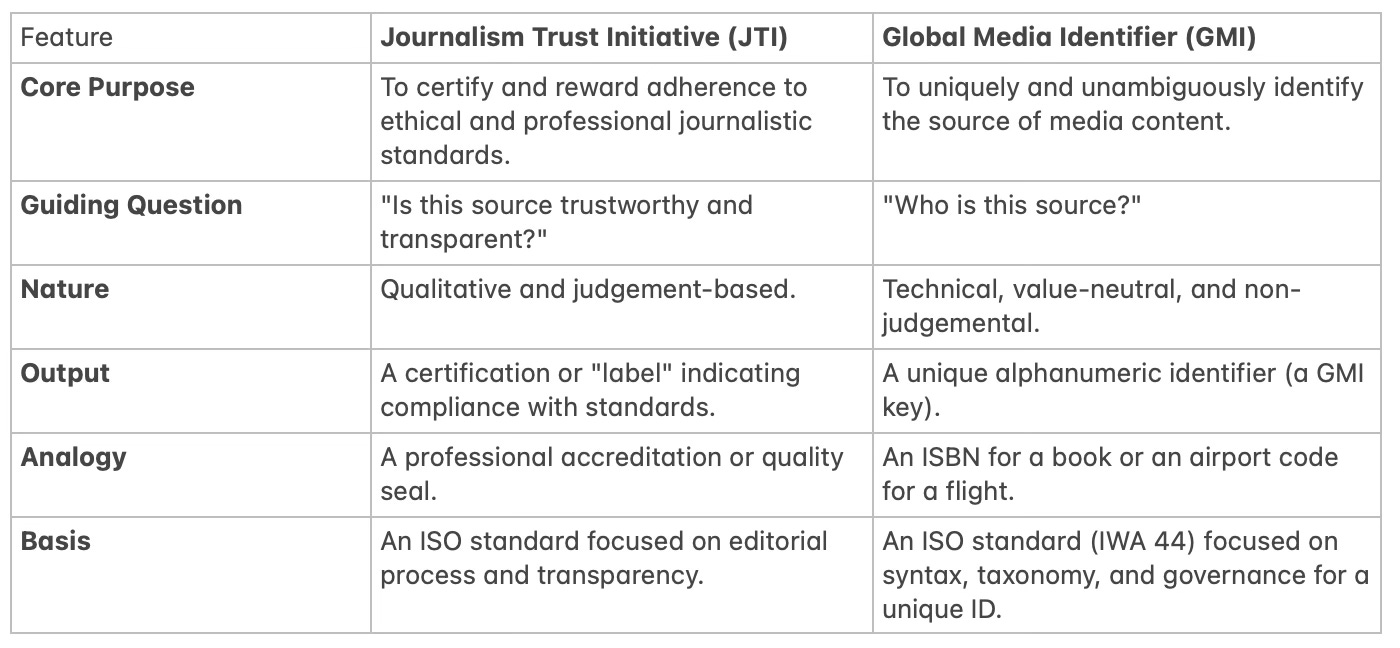
These two systems are designed to work in concert. Imagine a platform’s content moderation algorithm. It first encounters a new source and uses its GMI key to query a central registry, confirming its identity and ownership structure, solving the “who is who” problem instantly. In a second step, the algorithm checks the same registry for associated signals layered on that GMI key. Suppose it finds a valid JTI certification or another international certification*. In that case, it can confidently apply a different set of rules, giving the source’s content preferential treatment in recommendations or protecting it from automated strikes. This two-step process – unambiguous identification followed by qualitative assessment – is impossible without both layers, providing a robust framework for platforms, regulators, and consumers to make more informed decisions.
Charting a Path Towards News Integrity
The diagnosis from the États généraux de l’information and the operational systems developed by Reporters Without Borders and the Global Media Registry all point to the same architectural conclusion.
In the face of widespread information chaos, the most promising and durable solutions are not those imposed by governments, but those rooted in industry-led self-regulation, radical transparency, and the adoption of universal technical standards.
The recent political controversy in France and the US serve as a cautionary tale, underscoring the critical distinction between these professional, bottom-up initiatives and the politically fraught concept of top-down, state-mandated labelling. Whatever the future holds for news content, which is becoming irresistibly “liquid”, as promised by generative AI and LLMs, the path forward lies not in creating arbiters of truth, but in building an information architecture that makes the origins and standards of a news source transparent to all.
In this spirit, WAN-IFRA, the EBU and the FIPP have joined forces to defend five principles essential to preserving the integrity of news in the age of AI. Thousands of public and private news media around the world have joined the initiative, calling on AI developers to help ensure that Artificial Intelligence is safe, reliable, and beneficial to the news ecosystem and the public. The initiative – News Integrity in the Age of AI – proposes five key principles for a joint code of practice, inviting technology platforms to open dialogue and cooperation with media companies to counter the misinformation crisis and protect the value of trusted news.

* The Journalism Trust Initiative standard by Reporters Without Borders is referred to in this article, given the recent controversy caused by the French President’s remarks. News content today is increasingly certified or labelled through a mix of technical provenance standards, platform/regulatory labels, and newsroom-run “trust” or authenticity programs. The Trust Project “Trust Indicators” is a set of disclosures (e.g., author expertise, type of work labels separating news/analysis/opinion/advertising, methods, sourcing, corrections, local sourcing, diverse voices, and feedback channels) implemented by many publishers and used by platforms to better surface quality journalism. NewsGuard grants site-level nutrition labels with pass/fail across criteria such as credibility and transparency, accompanied by written rationales from trained analysts. The Coalition for Content Provenance and Authenticity (C2PA) provides an open technical standard for publishers, creators and consumers to establish the origin and edits of digital content.